
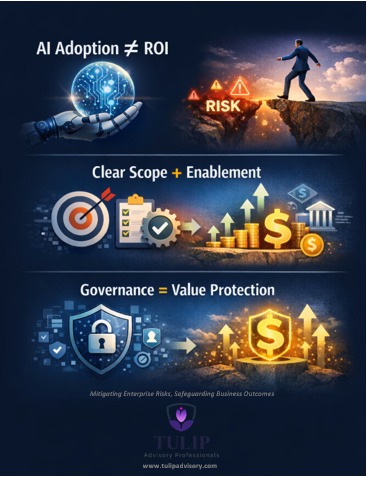
AI Adoption ≠ ROI. Without a Strategy, It’s Just an Experiment.
In today’s race to adopt AI, most organizations are tracking the wrong metric.
Adoption is being mistaken for success. However, adoption merely tells you that AI is present. It tells you nothing about whether it’s creating value or amplifying risk. In some instances, it’s doing both.
The Real Problem: Speed Without Scope
Organizations are moving fast - piloting tools, deploying models, experimenting across functions. However, too often, they’re skipping a critical step: Defining a clear, business-aligned AI use case.
Without scope:
AI lacks direction
Outputs lack accountability
Risks lack visibility
What you get is not transformation. You get fragmented capability layered on top of unmanaged exposure.
ROI on AI Starts With Precision, Not Proliferation
AI does not generate ROI simply because it is deployed. ROI is realized when AI is:
Tied to a defined business problem (cost reduction, revenue expansion, risk mitigation)
Structured for execution (clear ownership, workflows, and integration points)
Measured against financial outcomes (margin impact, cost savings, value protection)
If you cannot clearly articulate:
👉 What problem AI is solving
👉 How it changes a decision or process
👉 Where the financial impact shows up
Then you don’t have an AI strategy. You have an experiment.
Enablement Without Governance Is a Value Leak
Even with strong use cases, organizations often fail in the next phase: AI enablement without governance. That's because AI accelerates decisions. But it also accelerates errors, bias, and operational friction.
Without governance:
⚠️ Workforce trust erodes
⚠️ Data integrity weakens
⚠️ Contracts fail to account for AI risk exposure
⚠️ Decision velocity outpaces control systems
This is where AI quietly converts into financial risk.
The Missing Link: Governance as a Value Driver
Governance is often framed as a constraint. In reality, it is the mechanism that translates AI capability into sustainable ROI. Effective AI governance:
✅ Aligns AI use with enterprise risk thresholds
✅ Embeds accountability into workflows
✅ Protects data and decision integrity
✅ Ensures consistency between outputs and business objectives
In gist, governance is what turns AI from a tool into a performance system.
The Bottom Line
AI adoption is easy to measure. ROI is not because ROI requires discipline with:
Clarity of scope
Intentional enablement
Embedded governance
Anything less creates the illusion of progress while increasing exposure beneath the surface. Therefore, in the AI age, the question is no longer: “Are we adopting AI?” It’s: “Are we converting AI into measurable, protected value or accelerating unmanaged risk?”


Comments